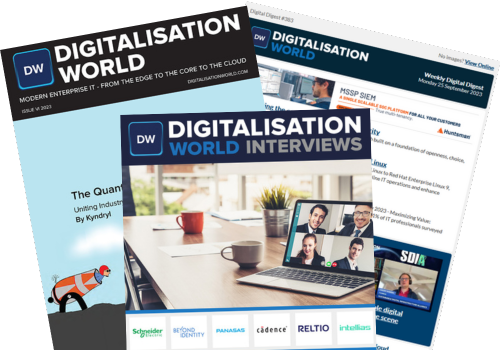
Digital Newsletter
Each week our editor Phil Alsop rounds up the most popular articles, videos and expert opinions. We compile this into a Digital Newsletter and send it straight to your inbox every week.
Digital Magazines
We'll let you know each time a new edition of Digitalisation World is released so that you're always kept up-to-date with the latest and greatest news and press releases.
Video Magazines
The Digitalisation World Video magazine contains the latest Zoom interviews with experts in the industry.
This year has seen digital sovereignty rise to the forefront of the global tech conversation. Owing to increased geopolitical and economic shocks, sovereignty concerns are intensifying, rather than being deprioritized. Many European organizations are currently assessing their dependency on foreign technology at a time that is decisive for continental relations.
This shift in thinking around digital independence is leading to a profound change in the psychology and perception of tech sovereignty amongst key decision makers. Understandably, conversations are turning to focus on questions around autonomy, data protection, and control over digital infrastructure. These concerns are valid, and it’s critical that as US organizations, we listen to them, and act upon them to work with Europe on Europe’s terms.
Defining digital sovereignty
Amongst all this uncertainty and shifting dynamics, the good news is that the technology to support this change exists and is already in use and proving its worth. However, digital sovereignty as a topic is constructively ambiguous and not standardized across the continent. So, before explaining how to deliver digital sovereignty and where Zero Trust security fits in, it’s worth taking a moment to define it in a manner that makes it concrete and actionable across Europe.
This is where the 5C approach becomes particularly useful. Acting as a practical way to define digital sovereignty, the 5Cs help organizations to move away from thinking of it as a vague political idea, and into a set of concrete expectations that customers can use to assess technology providers. To explain them in more detail:
By reducing dependency risk, keeping customers in charge of their data and operations, ensuring resiliency, championing local ecosystems, and meeting regulatory obligations, the 5C framework provides European companies with the ability to remain or regain sovereignty. When approached in the correct manner, digital sovereignty can act as a springboard for a more competitive Europe.
Delivering digital sovereignty
At its core, digital sovereignty is about being in control of data, staying independent, ensuring service continuity and demanding transparency. A Zero Trust platform approach for security underpins this ambition because it replaces the implicit trust in networks with continuous verification of every user and device. Through local processing and compliance with granular access controls, it’s uniquely positioned to support autonomy goals by keeping log data in Europe and providing real-time threat protection and secure access during disruptions.
Creating a more competitive Europe
Europe’s competitiveness agenda to a large extent runs through digital capacity, productivity, and resilience. The infamous Draghi report reflects the urgency - referencing technology and digitalisation more than 750 times - and frames digital investment as central to Europe’s economic strategy in a more contested environment. But let's be honest: Competitiveness without digital sovereignty is an anachronism. The tech industry has a responsibility to deliver on that agenda. A practical approach to digital sovereignty- choice and interoperability, control, continuity, trusted partnerships, and compliance by design - is the recipe that can both help reduce dependency risks while keeping Europe innovative and globally competitive.