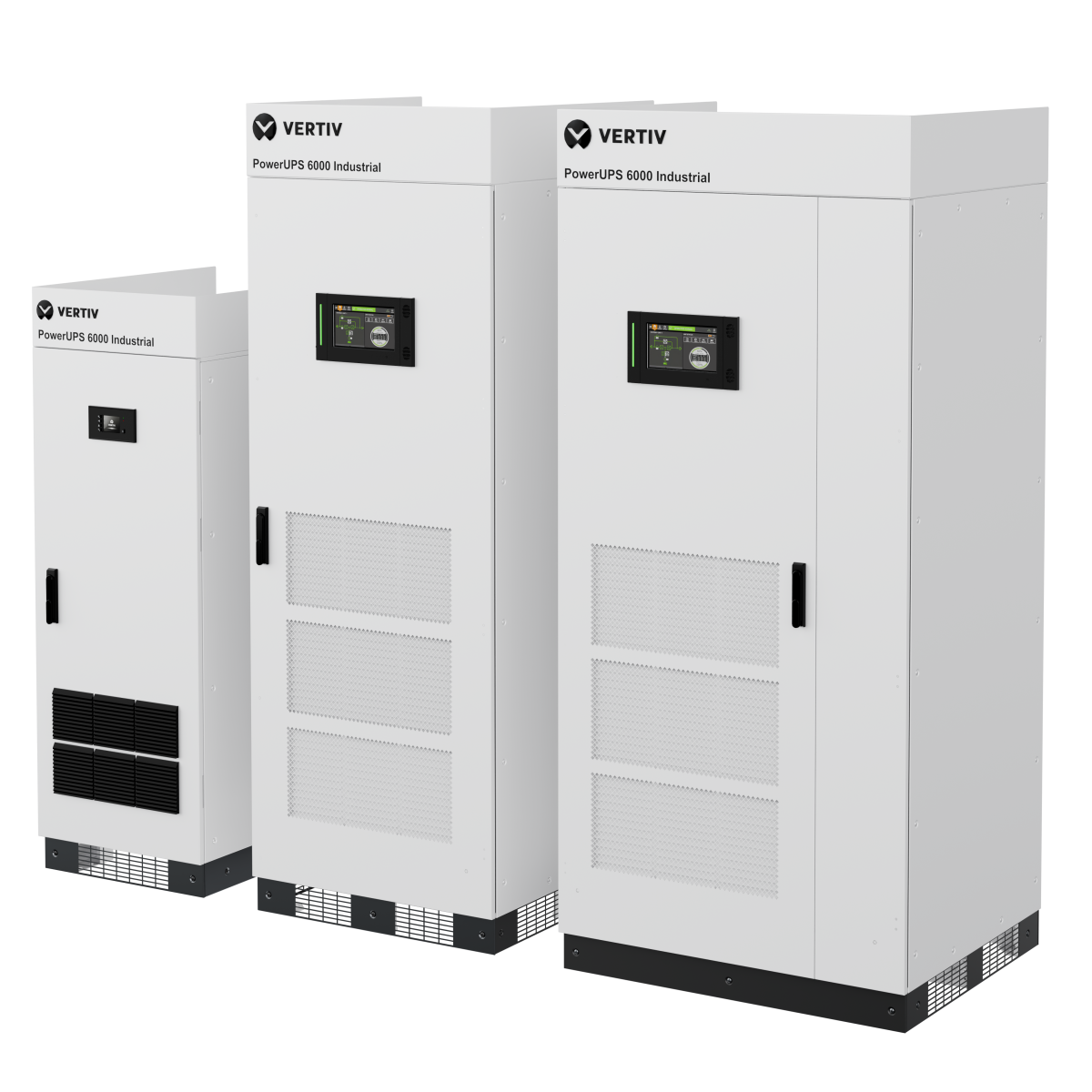
Vertiv has unveiled the Vertiv PowerUPS 6000 Industrial uninterruptible power supply (UPS) system, designed to meet the power protection requirements of commercial and industrial markets. The UPS supports industries including manufacturing, transportation, oil and gas, pharmaceuticals, and food and beverage.
“Industrial environments can face electrical instability, high temperatures, and airborne contaminants that traditional UPS systems aren’t built to withstand,” said Greg Funk, vice president of modular power converters at Vertiv. “The Vertiv PowerUPS 6000 Industrial is engineered specifically for Industry 4.0 applications, delivering reliable performance amid demanding environments that can result in power fluctuations and harsh conditions on factory floors, refineries, and production lines.”
The UPS has an Ingress Protection rating of IP42, providing protection against dust and humidity and operating at temperatures up to 50 °C (122 °F). It safeguards industrial control systems such as PLCs and SCADA systems, as well as industrial networking equipment, helping maintain production-line automation where reliable power is required.
The system features a compact cabinet design for space-constrained environments and front-access installation to simplify deployment, maintenance, and servicing. The UPS operates at up to 97% efficiency in double-conversion mode and 99% in ECO mode. It is compatible with valve-regulated lead-acid (VRLA), Nickel-Cadmium (Ni-Cd), and Lithium-Ion (Li-ion) battery cabinets to accommodate varying runtime requirements.
The UPS handles a wide input voltage range (-40% to +25%) and provides conditioned power with low harmonic distortion, reducing stress on upstream infrastructure. It supports parallel operation for capacity expansion and redundancy, while conformal-coated PCBAs offer protection against dust, moisture, and corrosion.
Certified to European standards EN 50121 and EN 50171, the Vertiv PowerUPS 6000 is designed for industrial applications requiring continuous power in challenging operational environments.