With the rise of AI-native organisations, teams are increasingly changing how work is executed across tools and workflows. Powered by Atlassian, organisations are adopting agentic automation, with reported growth of 7x over the last six months. This automation is used to handle routine execution tasks, allowing people to focus more on decision-making and higher-level work.
At the centre of this approach is Atlassian’s Teamwork Graph, a system that maps how work is completed across teams, tools, and platforms. It connects data from Atlassian products such as Jira and Confluence, as well as third-party systems, by modelling relationships between work items, people, and knowledge. With over 150 billion connections that update over time, it is designed to reflect organisational context and support AI use within workflows.
Atlassian is extending access to the Teamwork Graph through APIs and a command-line interface. This enables organisations to integrate their contextual data with external applications such as Figma and Microsoft 365, and to connect with external AI systems including Google Gemini and Microsoft Copilot. The intent is to allow organisational context to be used across different tools and environments.
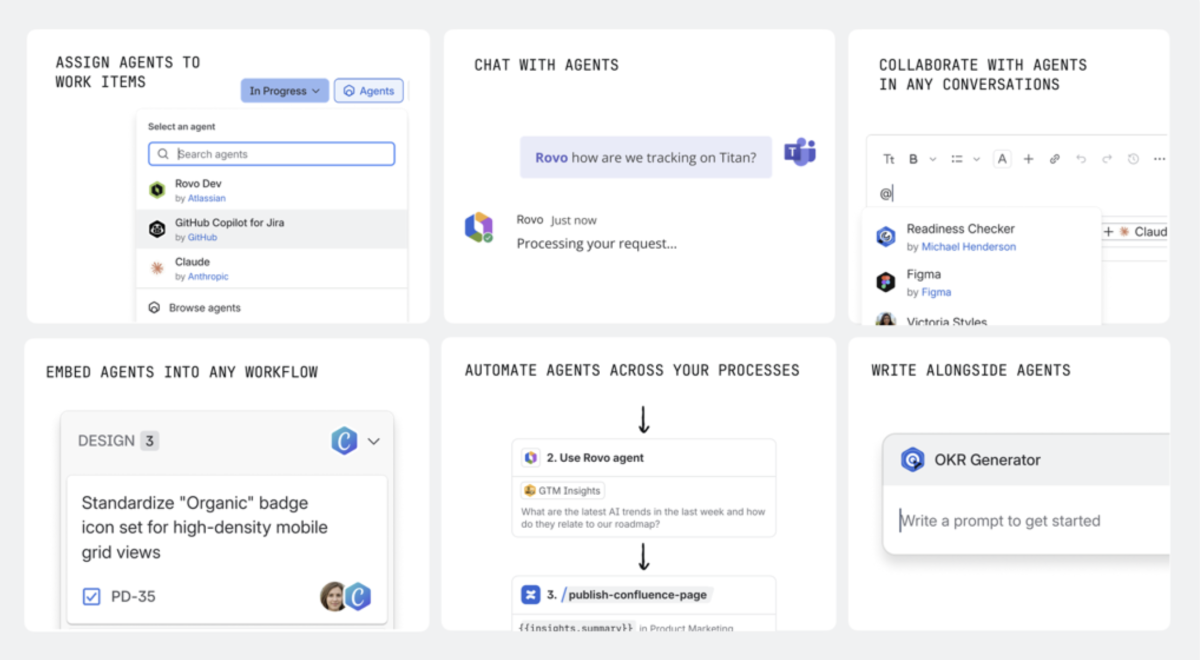
Rovo is an AI application built on the Teamwork Graph. It is used for a range of tasks, from basic queries to more complex workflow support, including search and task delegation functions. It has recorded over 14 million assisted actions in a month, indicating usage across day-to-day work activities.
Rovo also integrates across Atlassian tools and is being extended into browser-based workflows. This allows it to combine external information with internal organisational data to provide more context-aware outputs. It includes features that summarise user activity, such as upcoming tasks, meetings, and communications, to help users track work and priorities.
Rovo Studio allows teams to build workflows, create automations, and develop custom applications aligned with organisational requirements. It supports different levels of AI adoption, from assistance to embedded workflows and multi-agent orchestration. Governance features such as role-based controls, approvals, and usage visibility are included to support organisational oversight.
Rovo also includes capabilities for breaking down complex inputs into structured, multi-step action plans that can run with limited manual intervention while providing status updates. This can include converting notes into structured summaries or organising tasks into actionable lists.
Each interaction with Rovo contributes additional data back into the Teamwork Graph, which is used to update and refine organisational context over time. This is intended to improve the relevance of future outputs and automations.
From a governance perspective, organisations can manage AI usage through administrator-controlled connectors, enforce real-time permissions inherited from source systems, and apply data classification and redaction policies. AI agents can also operate under dedicated accounts with defined permissions to support access control and traceability.
As adoption continues, organisations are evaluating how AI-based processes can be incorporated into existing workflows, using a combination of contextual data, automation, and cross-platform integration.