At its annual Relate conference, Zendesk announced its vision for the Autonomous Service Workforce, an approach to customer service built on its core platform. The strategy centres on specialised AI agents operating across multiple channels rather than traditional bots. Zendesk stated that its objective is to focus on resolutions, with a pricing model tied to outcomes the company identifies as resolved.
The announcement addresses the challenge of organisations using disconnected systems within existing workflows, which can prioritise ticket deflection over resolving customer issues. At the centre of this approach is the Zendesk Resolution Platform, a unified system combining data, intelligence, knowledge, workflows, and governance. According to Zendesk, the platform is trained on approximately 20 billion ticket interactions and operates through the Resolution Learning Loop, designed to identify knowledge gaps and improve automated responses.
Several updates were introduced as part of what Zendesk describes as the transition to the “agentic era”:
- Agent Builder and Custom Agents: Zendesk introduced Agent Builder, a no-code interface that enables companies to create custom AI agents aligned with their business logic, with governance and oversight controls included.
- Expanded AI Agents: AI agents integrating with platforms such as ChatGPT and Gemini are intended to provide connected interactions. Zendesk’s acquisition of Forethought expands this initiative, including the introduction of the Zendesk MCP Server, which supports personalised customer assistance with verification features.
- Multilingual Support: Updates to Voice AI Agents include multi-brand support across more than 60 languages, extending Zendesk’s CCaaS capabilities.
- AI Agents for Employee Service: Using technology from the Unleash acquisition, these autonomous agents provide support within platforms such as Slack and Microsoft Teams while maintaining access permission controls.
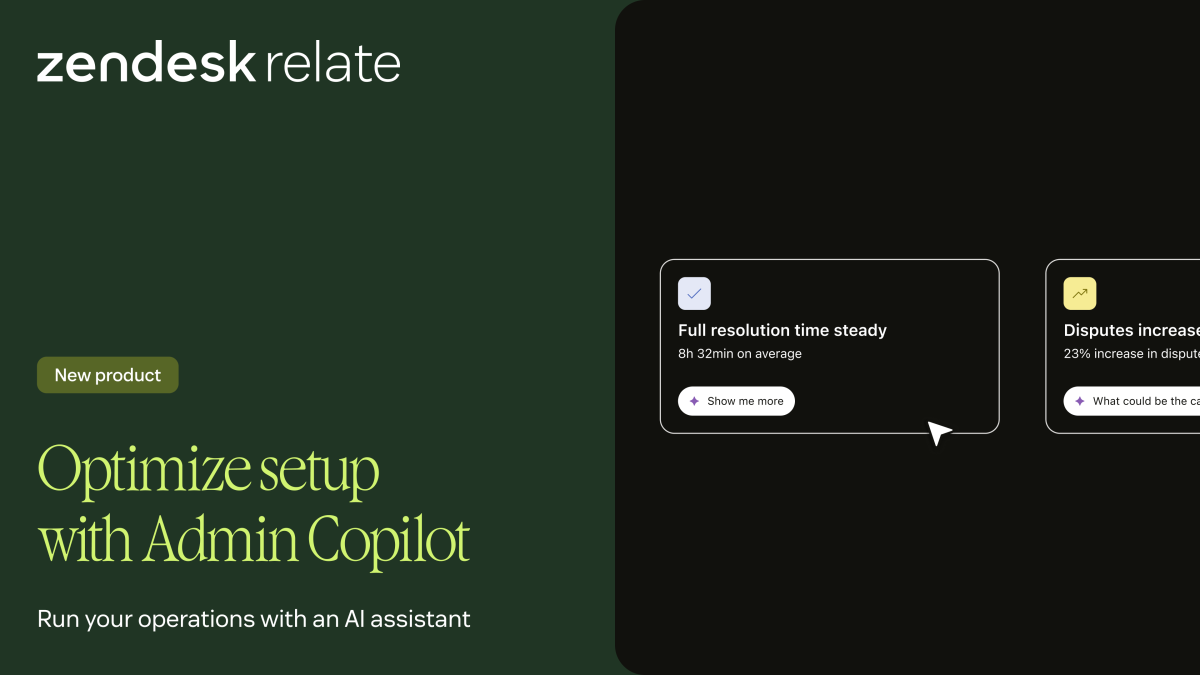
Zendesk also introduced updates including Copilot Experiences, designed to support human teams, and Quality Score technology for ongoing quality assurance.
Additional developments include the Context Graph, described as a memory layer intended to support agentic analytics, and an expanded Knowledge Graph with connectors for a range of external sources and systems.
Action Flows for AI agents are designed to support integrated workflows and broader engagement capabilities.
Zendesk also announced an outcome-based pricing approach in which charges apply only to interactions classified as fully resolved.