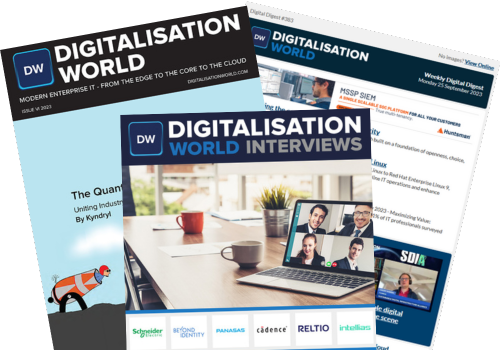
Digital Newsletter
Each week our editor Phil Alsop rounds up the most popular articles, videos and expert opinions. We compile this into a Digital Newsletter and send it straight to your inbox every week.
Digital Magazines
We'll let you know each time a new edition of Digitalisation World is released so that you're always kept up-to-date with the latest and greatest news and press releases.
Video Magazines
The Digitalisation World Video magazine contains the latest Zoom interviews with experts in the industry.
HCLSoftware has revealed its latest Tech Trends 2026 report, marking a shift in the digital landscape towards autonomous intelligence. The study, rooted in eight months of research and input from 173 enterprise leaders, highlights the transformation influence of AI-driven systems.
Key Takeaways
AI's role is expanding beyond simple assistance to fully autonomous agents capable of executing tasks end-to-end. In this evolving landscape, digital sovereignty becomes crucial, offering a control layer that safeguards compliance, data integrity, and stakeholder trust globally. Organisations embracing governance-by-design will scale with confidence, unlike those that may find themselves grappling with operational disarray and reduced accountability.
According to the report, the primary challenge isn't in deploying autonomy but rather in its design. Effective integration across experiences, data, and operations is important for ensuring autonomy becomes a consistent and reliable system feature rather than merely isolated instances. HCLSoftware's XDO (Experience, Data, and Operations) blueprint aims to provide a cohesive strategy to develop systems that are not only intelligent but also governed, autonomous, and efficient.
Kalyan Kumar, Chief Product Officer at HCLSoftware, highlighted this by stating that enterprises will redefine themselves through technology-enabled decision-making and self-governance. The coming years are pivotal for leaders to cultivate autonomously resilient and sovereign operational models.
Focusing on the future, the 2030 Trend Matrix illustrates the current convergence of technologies into industry-defining frameworks. Leaders are advised to build foundations in governance, talent, and architecture to effectively scale autonomy and orchestration while retaining control and trust. HCLSoftware predicts that: